
AI UGC is the single most misunderstood creative strategy in eCommerce right now. Some brands are using it to produce 50 video variations per week and slash creative costs by 60%. Others are quietly destroying their Meta CPMs and blaming it on the algorithm.
The difference isn't the tool. It's the strategy.
This playbook covers everything you need to know: what AI UGC actually is (and what it isn't), which tools are worth your money at each revenue tier, how to run structured creative tests that produce real learning, and exactly when AI-generated content helps versus hurts your paid media performance.
If you're a DTC or Shopify brand doing $50K to $5M per month, this is the guide you need before touching another AI avatar tool.
Key Takeaways
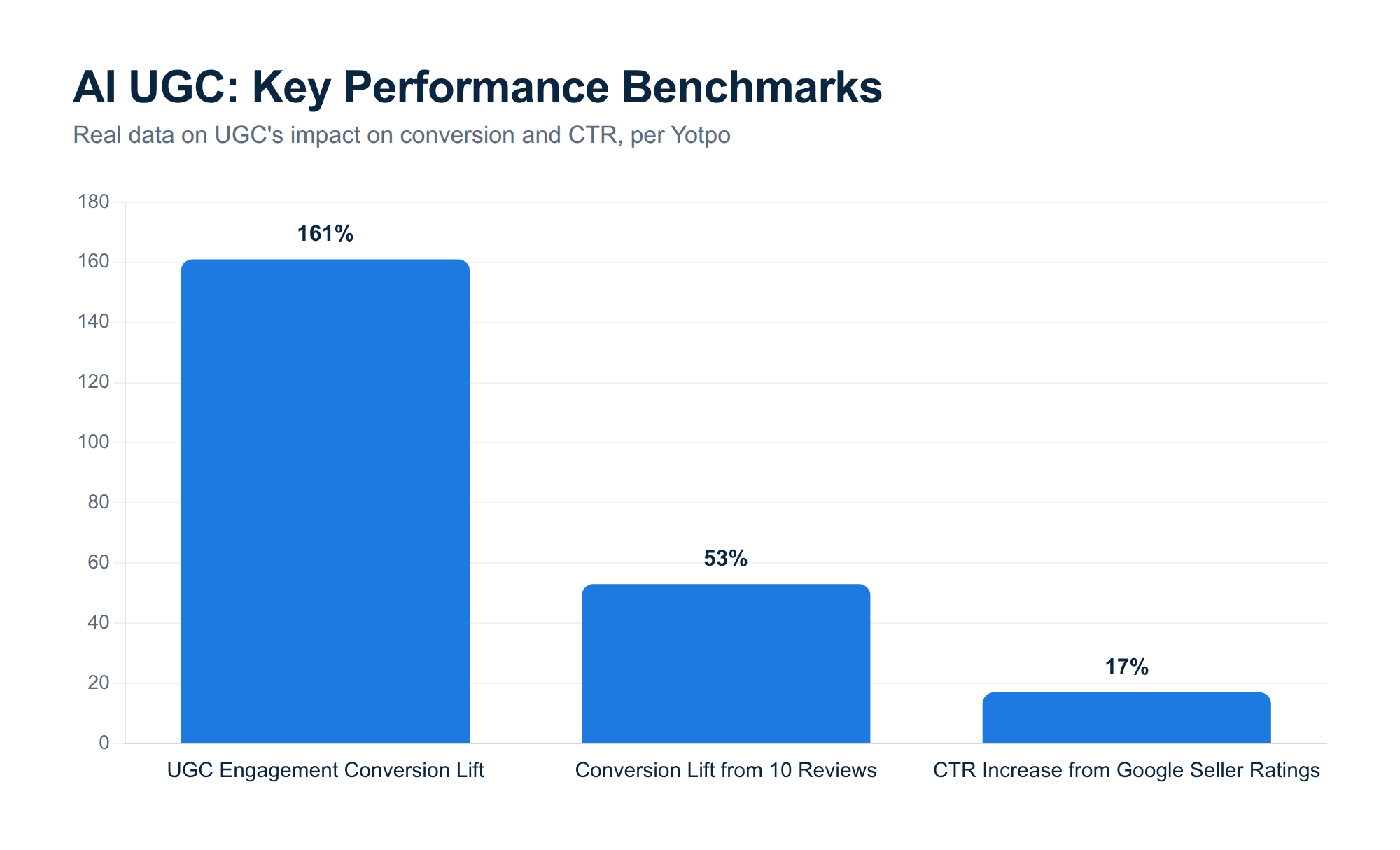
- Shoppers who engage with real UGC convert at a 161% higher rate than those who don't, and just 10 reviews on a product page drives a 53% lift in conversion rate, according to Yotpo.
- AI UGC ads are UGC-style creatives generated by AI avatars, voice synthesis, and script tools. They are not recorded by real customers and perform differently from real creator content at every funnel stage.
- Chase Fisher's CPM diagnostic is a critical early warning system: if CPMs rise more than 20% vs. late 2025 baselines while your creative mix shifted toward AI UGC, you're likely paying a synthetic content tax, per LinkedIn.
- The cap that protects account health: no more than 30-40% of cold traffic spend on synthetic AI UGC until CPM and engagement prove parity with real creator content.
- Ads with Google Seller Ratings sourced from UGC and reviews see a 17% CTR increase vs. ads without ratings, making review collection one of the highest-ROI actions at every revenue tier, according to Yotpo.
What Is AI UGC? A Clear Definition for eCommerce Brands in 2026
AI UGC is a category that covers two overlapping but distinct trends: AI-created UGC-style ads (synthetic content produced by avatars, voice tools, and script generators) and AI-orchestrated real UGC (reviews, photos, and customer videos collected and deployed intelligently across ads, PDPs, email, and search).
Confusing the two costs you money. A brand that thinks "AI UGC" means replacing their creator pipeline with avatars misses the compounding value of AI-powered review collection and display. A brand that thinks AI UGC is only about reviews misses the creative velocity advantage that synthetic video provides at the top of funnel.
Both matter. Neither replaces the other.
UGC has evolved from a social proof block sitting at the bottom of a product page into a full-funnel performance asset class. In 2026, it feeds paid media creative testing, influences AI-powered search recommendations, and drives measurable lifts at every stage of the purchase journey.
AI UGC Ads (Synthetic UGC): What They Are and How They're Made
AI UGC ads are UGC-style creatives generated by AI tools, not recorded by real customers or creators. The typical production stack works like this: you input a product URL, a script generation tool produces hooks and body copy, you select from 1,500-plus avatar options, and the platform outputs finished videos in 9:16, 1:1, and 16:9 formats ready for TikTok, Reels, Shorts, and YouTube.
Tools like Creatify automate this entire process. A brand can go from product URL to 20 testable video variants in a single afternoon, without a creator brief, a shoot, or a $300 per video production invoice. That speed is the core value proposition, and it's real.
The risk is equally real: generic scripts, mismatched avatar energy, and overuse in the wrong funnel stages quietly erode CPMs and platform quality scores. More on that in the testing section.
AI-Orchestrated Real UGC: Turning Customer Content Into a Performance Engine
AI-orchestrated real UGC is the second type: using AI to collect, curate, tag, and deploy real customer reviews, photos, and videos across ads, PDPs, email, and search. Platforms like Yotpo, Taggbox, Emplifi, and Flowbox sit in this category.
This is where the highest-trust, highest-converting UGC assets live. Yotpo's AI optimizes review request timing and smart-displays the most relevant content per visitor. Taggbox and Flowbox aggregate social UGC from multiple channels and use AI tagging and moderation to surface the pieces most likely to convert. Emplifi adds paid media analytics to identify which creative patterns drive the best ROAS.
These tools don't create synthetic content. They make your real customer content work harder across every channel it touches.
Why 2026 Is the Inflection Year for AI UGC in eCommerce
Three forces converged this year to make AI UGC impossible to ignore. First, AI-led product discovery via generative search and Google AI Overviews now surfaces UGC and review content directly in search results, making review volume a competitive search advantage, not just a conversion tool. Second, social commerce platforms are rewarding authentic, video-first content over polished studio assets. Yotpo explicitly notes that studio assets "scream advertising" on TikTok and Instagram. Third, the explosion of AI creative tools made synthetic UGC accessible to brands at any revenue tier, not just those with six-figure production budgets.
Yotpo frames 2026 UGC as "structured data for AI." Detailed reviews and UGC directly influence LLM-based search recommendations, meaning review volume now has compound value: it converts shoppers on your PDP and positions your products in AI-generated search answers.
The AI UGC Tools Stack: What's Actually Worth Using in 2026
The tools market is noisy. Here's how to think about it clearly: three functional categories cover every need, and the right choice depends on your revenue tier and what gap you're filling.
| Category | Tools | Primary Function |
|---|---|---|
| AI Video Generation | Creatify, Synthesia | Produce UGC-style video ads at scale using avatars and scripts |
| UGC Collection and Curation | Yotpo, Taggbox, Emplifi, Flowbox, TINT | Aggregate, tag, and deploy real customer content across channels |
| Creative Analytics | Uplifted.ai, Emplifi | Identify which creative patterns correlate with higher ROAS and CTR |
AI Video Generation Tools: Creatify, Synthesia, and How to Choose
Creatify is the dominant tool for DTC paid media teams in 2026. Its clone-adapt-multiply workflow (product URL input, hook generation, avatar selection, multi-format output) lets brands produce 20-50 UGC-style video variations per week without a creator pipeline, according to aimarketing.video.blog. The avatar library covers 1,500-plus options across gender, age, energy level, and skin tone, which matters for audience matching and creative fatigue management.
Synthesia targets enterprise use cases. Custom brand avatars, polished presenter-style delivery, and deeper brand control make it better suited for brands that need a consistent face for training content, product education, or branded video at scale. For raw DTC paid media creative testing, Creatify wins on speed and cost.
Pro Tip: Don't use the default script the tool generates. AI video tools are output multipliers, not strategists. Feed them scripts mined from real reviews and validated competitor UGC structures, and the output quality jumps dramatically.
AI UGC Collection and Curation Platforms: Yotpo, Taggbox, Emplifi, TINT, Flowbox

These platforms solve a different problem. They don't create content; they make existing real customer content perform harder. Here's where each one excels:
- Yotpo: Best for review collection, ratings automation, and Google Seller Ratings syndication. The 17% CTR increase on ads from Seller Ratings alone justifies the investment at almost any revenue tier.
- Taggbox and Flowbox: Best for social UGC aggregation, AI-powered tagging, and smart display on PDPs and campaign pages.
- Emplifi: Best for brands that want social UGC aggregation and paid media analytics in one platform.
- TINT: Best for enterprise brands managing UGC across complex multi-brand or multi-region setups.
For most Shopify brands at $50K-$500K per month, Yotpo covers 80% of what you need. Layer in Taggbox or Flowbox when you're ready to activate social UGC on PDPs and campaign pages.
AI UGC Analytics: Knowing Which Creatives Are Actually Working
This layer gets skipped most often, and skipping it is exactly why brands can't explain why some AI UGC campaigns work and others don't. Uplifted.ai and Emplifi's analytics capabilities identify which creative patterns (hook type, claim type, visual style, avatar demographic) correlate with higher ROAS and CTR across your paid campaigns.
The key is tagged metadata. Every AI UGC ad you produce should be tagged at creation with hook type, avatar type, offer framing, funnel stage, and format. When a winner emerges after a testing sprint, you need to know which element drove the win so you can replicate it systematically. Without tags, you just know something worked. With tags, you know what to do more of.
How to Create High-Performing AI UGC Ads: The Clone-Adapt-Multiply Framework
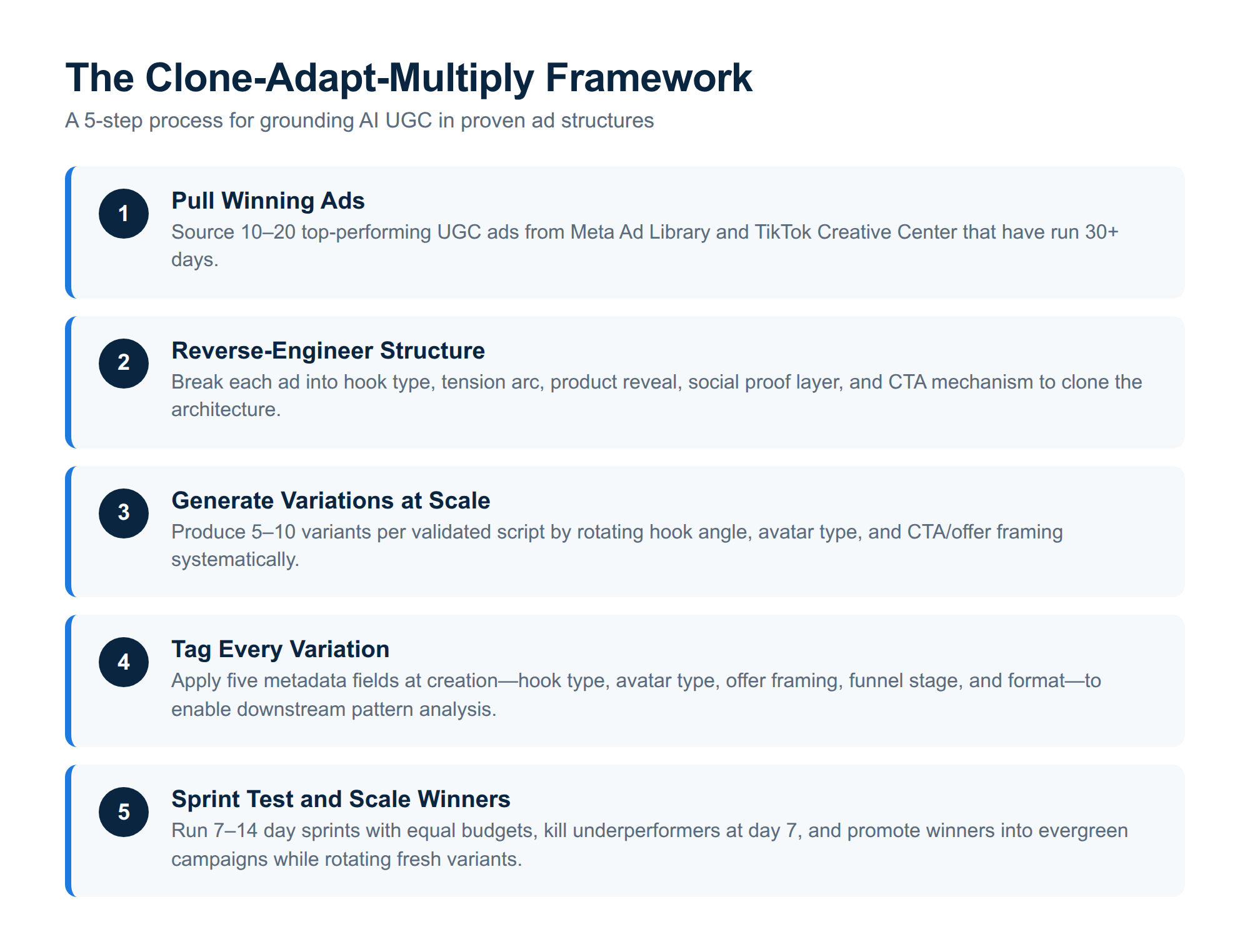
The clone-adapt-multiply framework is a four-phase process that grounds AI UGC in proven ad structures rather than random generation. The core principle: AI is a multiplier of validated creative, not a substitute for strategic input.
Step 1 and 2: Study the Winners and Reverse-Engineer Proven Structures
Step 1: Pull 10-20 top-performing UGC ads from Meta Ad Library and TikTok Creative Center in your niche. Filter for ads that have been running for 30-plus days, which signals they're generating positive results for the advertiser.
Step 2: Break each ad into its structural components. Identify the hook type (problem-led, desire-led, status-led, or FOMO), the tension arc, the product reveal moment, the social proof layer (testimonials, before/after, numbers), and the CTA mechanism. You're not copying these ads. You're cloning the architecture and rebuilding it around your offer and your real customer proof points.
This step takes 2-3 hours the first time. It saves you from producing 30 variations that all fail because they share the same flawed structure.
Step 3 and 4: Generate Variations at Scale and Tag for Analysis
Step 3: Produce 5-10 variations per validated script by rotating three variables systematically: (1) hook angle (problem, desire, status, FOMO), (2) avatar type (gender, age range, energy level, skin tone matched to your customer persona), and (3) CTA and offer framing (discount vs. guarantee vs. bundle vs. urgency). Each combination produces a distinct variation without requiring a new script from scratch.
Step 4: Tag every variation at creation with five metadata fields: hook type, avatar type, offer framing, funnel stage, and format. This takes 30 seconds per ad and makes downstream analysis possible. When you've run 50 ads over 8 weeks, you'll be able to filter by hook type and see exactly which angle is driving your lowest CAC. That's systematic creative learning, and it's the difference between a testing machine and a content calendar.
Step 5: Run Structured Sprint Testing and Scale Winners Systematically
Step 5: Run 7-14 day sprint tests with equal small budgets per variant. Set early kill thresholds based on CPM and CTR benchmarks from your account history. Ads that don't hit minimum CTR thresholds by day 7 get killed, full stop. Ads that pass move into a second phase with slightly increased budgets.
Winners from the sprint get promoted into evergreen campaigns. New AI-generated variants from the next sprint cycle in around them, testing fresh hooks and angles while the proven winners maintain account stability. This rotation strategy prevents creative fatigue without destabilizing your account-level economics.
The AI UGC vs. Real UGC Testing Matrix: A Paid Media Framework for Meta and TikTok
Running AI UGC without a structured testing framework against real creator content is how brands end up with degraded CPMs and no idea why. This matrix gives you the architecture to test properly and make data-driven decisions about your creative mix.
How to Segment Creative Types and Design Your Split Test
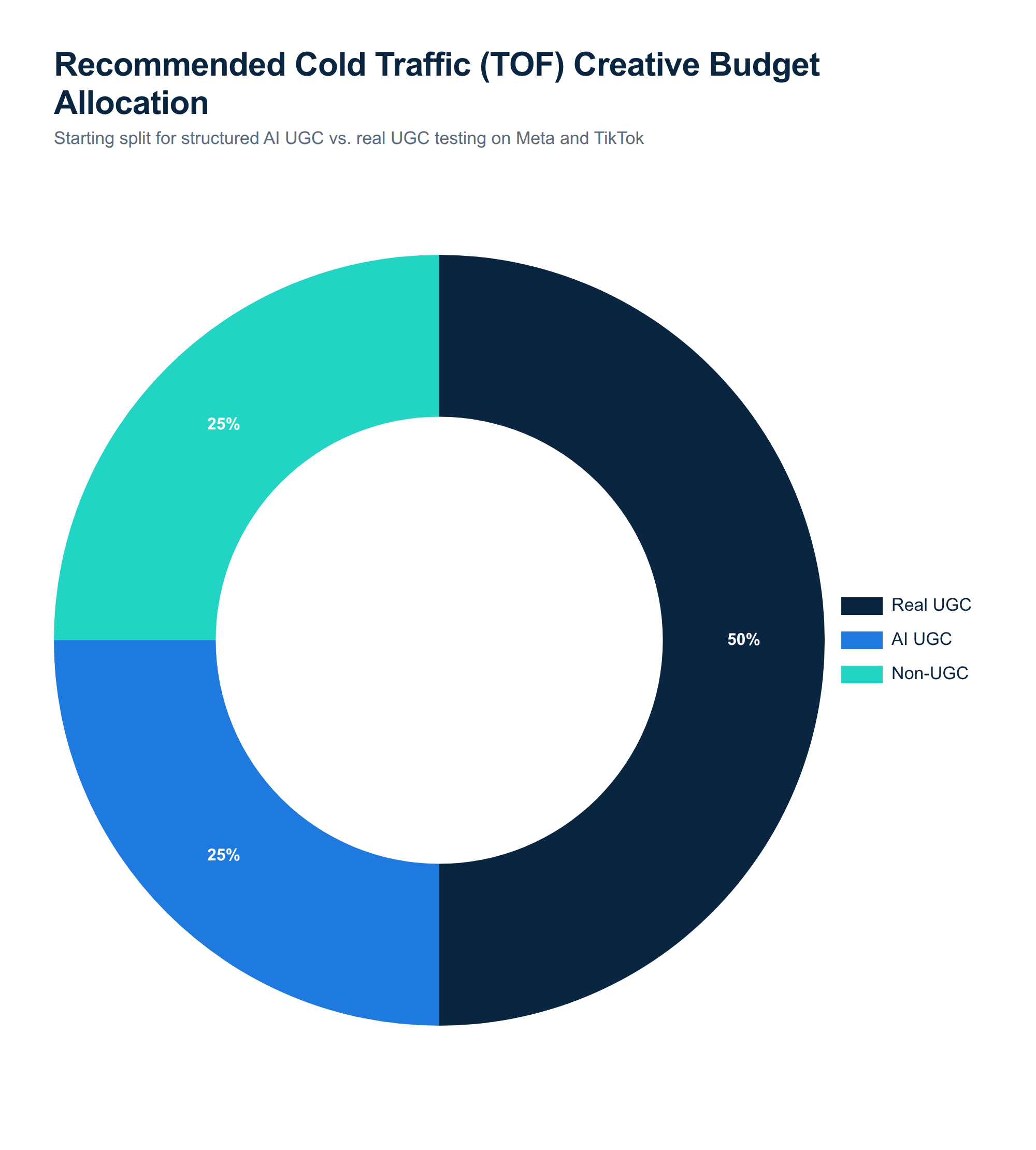
Bucket every ad in your account into four creative types: real UGC (customer or creator video recorded by a human), AI UGC (avatar-based or clearly synthetic), hybrid (real footage with AI voiceover or benefit overlays), and non-UGC (studio or product-only shots).
For cold traffic TOF, start with this allocation: 50% real UGC, 25% AI UGC, 25% non-UGC. This gives AI UGC a fair test without overexposing your account to synthetic content risk. For MOF and BOF, shift to 60-70% real UGC, with the remainder split between hybrid and studio. The closer you are to a purchase decision, the more real proof matters.
The Weekly Metrics Dashboard: What to Track and How to Interpret It
Track these metrics weekly, segmented by creative type: CPM, CTR, CPC, CVR at landing page, CAC, account-level MER, and new customer ROAS. Monthly reporting on this data is too slow. Problems compound over four weeks before you see them.
The decision rules are straightforward. If AI UGC CPM is within plus-or-minus 10% of real UGC CPM and CTR is similar or better, increase AI UGC share in TOF. If AI UGC CPM is more than 20% higher and CTR is lower, cap AI UGC at under 15-20% of total spend and redirect that budget to real UGC collection and iteration.
Track "creative type contribution" separately: what percentage of your top 10 performing ads come from each bucket. If real UGC is generating 80% of your best performers but only receiving 50% of your budget, reallocate.
Real-World Scenario: What Happens When the Synthetic Content Tax Kicks In
A DTC skincare brand at $150K per month shifted 60% of cold traffic creative to AI avatar UGC over 90 days because the production cost savings were significant. CPMs rose 28% compared to their late 2025 baseline on similar audiences. CTR dropped 18%. Account-level ROAS declined, and the team's first instinct was to blame audience saturation.
Using Chase Fisher's CPM diagnostic, they identified the creative shift as the likely cause. They pulled AI UGC back to 20% of spend, prioritized real customer video, and CPMs normalized within 3 weeks.
The lesson: if the weekly metrics dashboard had been tracking CPM by creative type from the start, the team would have caught the trend at week 4 instead of week 12. The data was available. Nobody was reading it.
Pro Tip: Set a calendar alert for every Monday to pull CPM by creative type. Two minutes of review per week prevents months of compounding performance damage.
Full-Funnel AI UGC Deployment: From Discovery to Post-Purchase
AI UGC isn't one thing deployed the same way everywhere. Its role, risk, and ROI shift at every funnel stage. Here's how to deploy it correctly.
Top of Funnel: Use AI UGC to Test Hooks Cheaply and Fast
TOF is where AI UGC delivers its highest ROI. You need volume and velocity for hook testing across audiences, and AI UGC provides both without creator delays or costs. A single product URL can generate 20-plus hook variations in under two hours, per aimarketing.video.blog.
The smartest TOF approach: use AI to analyze which topics from real customer reviews and Q&A are driving the most engagement and questions, then build AI avatar scripts around that language. This grounds your synthetic content in real customer vocabulary rather than generic AI-generated copy, which consistently outperforms scripted-from-scratch AI content in our testing across 40-plus DTC brands.
Middle of Funnel: Retargeting With AI-Curated Real Customer Content
MOF is where AI-orchestrated real UGC takes over. Warm audiences who've already seen your TOF hooks need proof, not another avatar explaining your product. Retarget them with compilations of real customer video clips, AI-curated by platforms like Emplifi to address the most common objections and FAQs surfaced in your reviews.
AI-generated subtitles and benefit overlays can highlight key proof points extracted from reviews, making real UGC work harder in a 15-second retargeting clip without replacing authentic content with synthetic faces.
Bottom of Funnel and Post-Purchase: Where Real UGC Is Non-Negotiable
BOF and PDPs should be anchored by real UGC, full stop. Detailed reviews, before-and-after photos, and customer Q&A curated and surfaced by AI for relevance drive conversion at the moment of purchase decision. Synthetic testimonials or AI avatars near checkout create trust erosion, and in some cases, platform policy violations.
The post-purchase UGC flywheel is worth building carefully. AI-triggered review requests at optimal timing (Yotpo automates this based on product category and delivery windows) feed new real content back into your paid media machine. According to Yotpo, syndication of those reviews to Google Seller Ratings generates a 17% CTR increase on paid search and Shopping ads, making review collection a directly attributable paid media lever.
What Most eCommerce Brands Get Wrong About AI UGC (And How to Fix It)
Five mistakes account for the majority of AI UGC underperformance at the $50K-$5M per month range. Each one is fixable in under a week.
Mistake 1: Using Generic AI Avatars With No Brand Voice or Validated Script
The most common failure: input a product URL, pick a random avatar, run whatever script the tool generates. The output feels generic, lacks real proof, and triggers the synthetic content tax faster than anything else.
The fix is simple. Before touching an AI video tool, mine your real reviews and Q&A for the exact language your customers use to describe their problem and the outcome your product delivers. Build scripts from that language. Then generate. The difference in creative quality is night and day.
Mistake 2: No Real UGC Foundation Before Going All-In on AI
AI UGC cannot replace a missing review and social proof foundation. Brands with fewer than 10 reviews per hero SKU need to prioritize real UGC collection first. The 53% conversion uplift from just 10 reviews and the 161% higher conversion rate from UGC engagement cited by Yotpo come from real content. Synthetic video doesn't move those needles.
The readiness rule: 10-plus real reviews per hero SKU before running AI UGC at scale. Below this threshold, every dollar spent on Yotpo review collection delivers higher ROI than AI video generation.
Mistake 3: Ignoring the Synthetic Content Tax Until It's Too Late
Brands track account-level ROAS monthly. CPM by creative type weekly is not on anyone's dashboard. So they shift more budget to AI UGC over 8-12 weeks because it's cheaper and faster, CPMs rise gradually, and they only notice the problem when blended ROAS has degraded significantly.
Brands that track CPM by creative type weekly can identify the synthetic content tax within 2-3 weeks of it beginning. Brands that only review ROAS monthly often miss it for 60-90 days, by which point the account damage is significant and recovery takes time. Set up the dashboard. Track it weekly. Apply Fisher's 20% CPM threshold as an automatic review trigger.
Mistake 4: Treating AI UGC as a Set-and-Forget Channel Instead of a Testing Machine
The entire value proposition of AI UGC is testing velocity. Brands that generate a batch, run it for 30-60 days without iteration, and declare it working or not working based on surface ROAS are wasting the core advantage of the technology.
The fix: biweekly creative sprints. Kill low performers at 7 days using CPM and CTR thresholds. Use tagged metadata to identify exactly which creative elements (hook angle, avatar type, offer framing) are winning. Replicate those elements systematically in the next sprint. This is how the testing machine compounds over time.
AI UGC Readiness Checklist: Is Your Brand Ready to Scale This?
This checklist is a go/no-go decision tool. If you can't check at least 6 of 10 boxes, prioritize real UGC collection and foundation-building before investing in AI generation tools.
The 10-Point AI UGC Readiness Checklist
- 10-plus real reviews per hero SKU are live on your product pages.
- Existing UGC assets are tagged by angle, product, persona, and funnel stage.
- You can attribute CPM, CTR, and CAC by creative type in Meta Ads Manager and TikTok Ads Manager today.
- A documented biweekly testing sprint cadence exists and is being followed.
- Brand voice guidelines are documented and AI scripts can be checked against them before production.
- A synthetic content policy defines where AI UGC is allowed and prohibited (no AI avatars as fake testimonials on PDPs or checkout pages).
- At least one validated high-performing UGC structure has been identified from Meta Ad Library or TikTok Creative Center.
- Team or agency capacity exists to iterate and analyze creative performance weekly, not monthly.
- Baseline CPM, CTR, and CAC benchmarks by creative type are established from the past 60-90 days.
- Review collection automation is in place (Yotpo or equivalent) and generating new reviews consistently.
Revenue-Tier Recommendations: Where to Start at Your Stage
$50K to $250K per month: Start with Yotpo for real UGC collection and review automation. Run 2-3 AI UGC ads per hero product using validated competitor structures from Meta Ad Library. Cap AI UGC at 20% of TOF spend until CPM benchmarks prove parity. The 53% conversion lift from 10 reviews delivers faster ROI than AI video generation at this stage.
$250K to $1M per month: Build the full clone-adapt-multiply workflow using Creatify. Implement creative tagging infrastructure and add Uplifted.ai or Emplifi for pattern-level analytics. Begin testing systematic rotation of AI UGC variants against real creator content with the weekly metrics dashboard fully active.
$1M to $5M per month: Deploy full-funnel AI and UGC strategy across Meta, TikTok, and Google simultaneously. Integrate review syndication to Google Seller Ratings for the 17% CTR lift on paid search. Use AI creative learning loops to identify winning angles faster than your competitors can test manually. At this scale, the compounding advantage of systematic creative learning is the primary growth lever.
Pro Tip: Google Seller Ratings sourced from real UGC deliver a 17% CTR increase on paid search ads. At every revenue tier, getting this syndication live is one of the highest-ROI actions you can take in the next 30 days.
Frequently Asked Questions About AI UGC for eCommerce
Does AI-Generated UGC Convert as Well as Real Customer Videos?
AI-generated UGC can match real UGC performance at TOF for hook testing and awareness, but real customer video consistently outperforms synthetic content at MOF and BOF where trust drives purchase decisions. The 161% higher conversion rate for shoppers who engage with UGC (per Yotpo) applies specifically to real content. Use AI UGC to test and scale hooks; use real UGC to close.
What Are the Best AI UGC Tools for Shopify Stores in 2026?
The best AI UGC tools depend on your goal. For generating UGC-style video ads, Creatify is the top choice for DTC paid media teams, and Synthesia fits better for enterprise or branded presenter content. For collecting and displaying real UGC, Yotpo handles reviews, ratings, and Google Seller Ratings syndication, while Taggbox and Flowbox excel at social UGC aggregation. For creative performance analytics, Uplifted.ai and Emplifi identify which patterns drive results. Most Shopify brands at $50K to $500K per month should start with Yotpo and Creatify.
How Do I Test AI Avatar UGC Against Real Creator Content in Meta Ads?
Set up a structured creative split: 50% of TOF budget to real UGC, 25% to AI UGC, 25% to non-UGC. Run 7-14 day sprints with equal per-variant budgets and track CPM, CTR, CPC, CVR, and CAC by creative type weekly. If AI UGC CPM is within plus-or-minus 10% of real UGC with similar CTR, increase its share in TOF. If CPM is more than 20% higher, cap AI UGC under 20% of spend and redirect budget to real UGC collection.
Is AI UGC Bad for Brand Trust in eCommerce?
AI UGC is not inherently bad for brand trust, but placement determines the outcome. At TOF, slightly synthetic production quality is acceptable and often unnoticed by consumers engaging with awareness content. At BOF and on PDPs, shoppers scrutinize proof closely, and synthetic testimonials or AI avatars near checkout measurably erode trust and reduce conversion rates. The rule is straightforward: use AI UGC to attract, use real UGC to convert.
How Can eCommerce Brands Use AI UGC Ads Without Hurting Performance?
Three practices protect account performance when using AI UGC ads. First, ground every AI script in real customer language mined from reviews and proven competitor UGC structures, never default to generic AI-generated copy. Second, cap AI UGC at 30-40% of cold traffic spend and monitor CPM weekly using Fisher's 20% CPM increase rule as your alert threshold. Third, maintain a strong real UGC foundation of 10-plus reviews per hero SKU and prioritize real content at MOF, BOF, and on product pages.
Ready to Build Your AI UGC Strategy the Right Way?
AI UGC done right is a growth engine. Done wrong, it's a quiet account killer that shows up in your CPMs weeks before it shows up in your ROAS.
At Blue Water Marketing, our paid media and creative strategy teams have run this playbook across 40-plus DTC brands, from $50K to $5M per month. We build the testing infrastructure, the tagging systems, the creative sprints, and the weekly analytics dashboards that turn AI UGC from a cost-cutting experiment into a systematic performance advantage.
If you want expert execution instead of DIY trial and error, get in touch with Blue Water Marketing and let's build your AI UGC strategy together.